Made in SF with ❤️


Last updated: February 2026
TL;DR: San Francisco is the robotaxi capital of the world right now, and yes, you should absolutely take a ride. Waymo is the gold standard — fully driverless, covers all of SF plus the Peninsula, and averages about $19.69 per ride. But it’s not the only game in town anymore. Tesla’s robotaxi service launched in the Bay Area (cheaper but has a safety driver), and Zoox is offering free rides in a wild-looking custom vehicle with no steering wheel. Here’s everything you need to know about all three.
Riding a self-driving car used to feel like a quirky futuristic novelty. In 2026, it’s genuinely just… how a lot of us get around San Francisco. Whether you’re visiting or you just moved here, taking a robotaxi is one of those uniquely SF experiences that’s absolutely worth trying — and honestly, you might prefer it to a regular rideshare.
Waymo: The One Most People Use
What is Waymo?
Waymo is a fully driverless car service owned by Alphabet (Google’s parent company). They’ve been testing autonomous vehicles on SF streets for years, but the commercial ride-hailing service — Waymo One — has really hit its stride. As of early 2026, Waymo is providing over 400,000 paid rides per week across its markets and recently raised $16 billion to fuel even more expansion. This is not a small experiment anymore.
If you remember Cruise (the other robotaxi company from a few years back), California revoked their permit after an unfortunate incident in 2023. Waymo has been the dominant robotaxi in SF ever since, and they’ve scaled up significantly.
What Car Does Waymo Use?
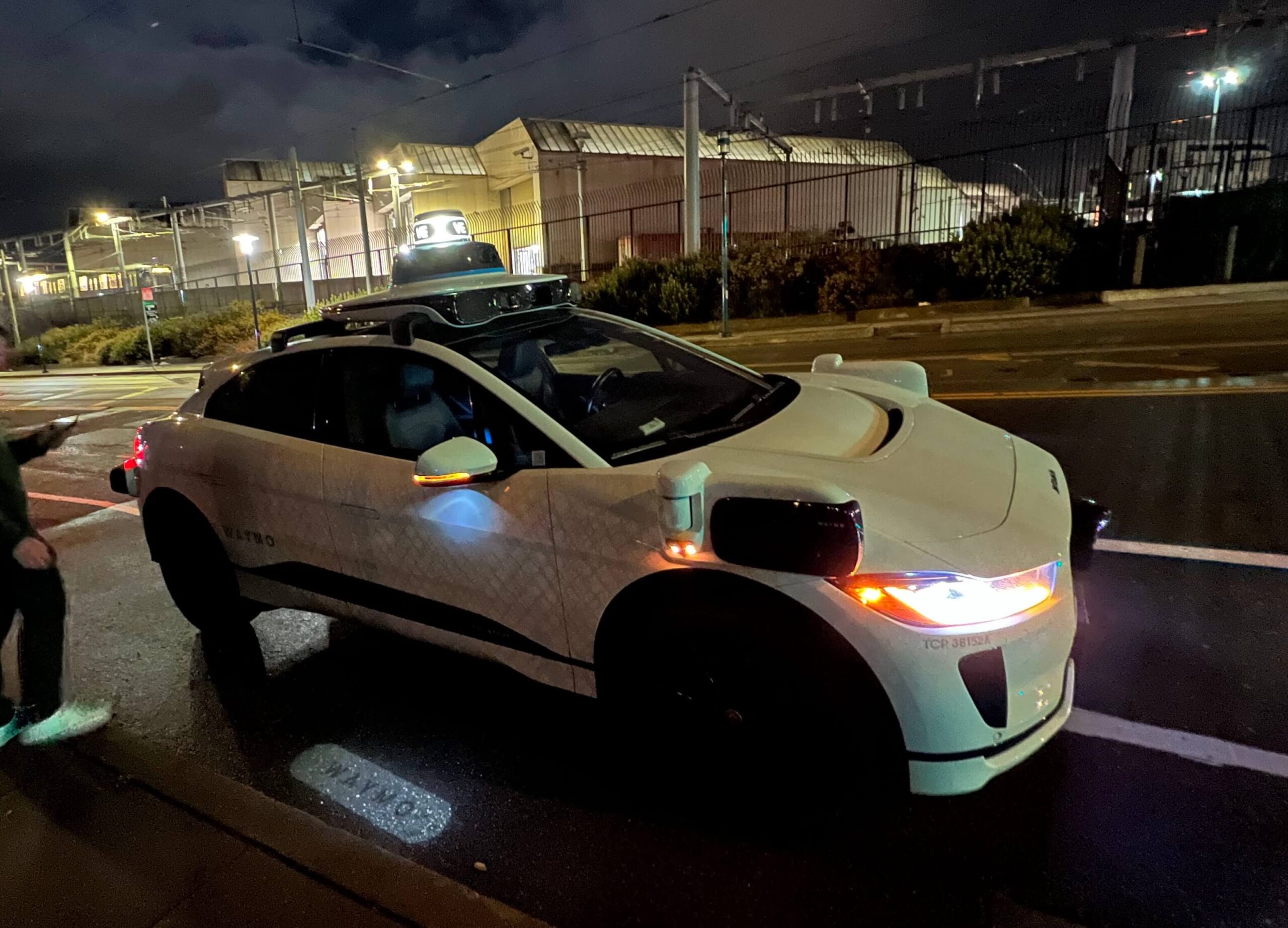
Right now, you’ll be riding in a kitted-out Jaguar I-PACE — an all-electric luxury SUV that’s genuinely nice inside. Each car has a distinctive dome on top (the “LIDAR dome”) packed with sensors, cameras, and radar that give the car 360-degree awareness of everything around it. It also lights up with your initials when your ride arrives, which is a fun touch.
Coming soon: Waymo is rolling out their 6th-generation vehicle called the “Ojai” — a roomier ride built on a Zeekr platform with a lower step-in, higher ceiling, and even better sensors. It’s currently in employee testing and should be available for public rides later in 2026.
What It’s Like Riding in a Waymo
It’s a Jaguar, so it’s really nice inside. There’s no human driver — just a large screen where you can control music, climate, and see your route in real-time. You’ll be prompted to buckle your seatbelt, and then you’re off.
My first Waymo ride was a few years ago, and I was genuinely impressed by how smooth it was. My only prior self-driving experience was Cruise, which felt a bit like riding with a nervous student driver — slightly jerky steering and hesitant turns. Waymo, on the other hand, drives better than most of my friends. The acceleration is smooth, the turns are confident, and it handles SF’s hills without drama.
I have several friends who actually prefer Waymo now — especially for privacy (no small talk, no one listening to your phone call) and for the consistent experience. You always get a clean car, no detours, and the ride is quiet.
Where Can You Take a Waymo?
This has changed dramatically since the early days. Here’s where Waymo goes in 2026:
- All of San Francisco — the full 47 square miles, from Fisherman’s Wharf to the Excelsior, Ocean Beach to the Embarcadero
- The Peninsula down to San Jose — a unified 260+ square mile zone covering San Bruno, San Mateo, Palo Alto, Mountain View, and more
- Freeways — since November 2025, Waymo rides can take Highway 101, I-280, and SR-92 when a freeway route is meaningfully faster (you can opt in via the app)
- SFO Airport (beta) — launched January 2026! Pickup and drop-off at the Rental Car Center (Level 1 Curbside), accessible via AirTrain from the terminals. This is still in beta, so availability may vary.
- SJC Airport — San Jose Mineta International also has curbside Waymo service
The SFO airport service is a game-changer for visitors once it’s fully rolled out. No more expensive taxis or dealing with rideshare surge pricing after a long flight. Just note that pickup is at the Rental Car Center, not the terminal curb — take the free AirTrain over.
How Much Does a Waymo Ride Cost?
The average Waymo ride costs about $19.69. Here’s how that compares:
- About 13% more than Uber (down from 30-40% more in mid-2025)
- Roughly comparable to Lyft depending on the route and time
You see the exact fare before you book, so no surprises. Pricing is based on the most direct route, and it won’t change even if the car reroutes. There is some surge-style pricing during busy times (weekend nights, for example).
Pro tip: First-time riders can get $10 off with a referral code — ask a friend who rides Waymo or search online for current codes. You can also sometimes book Waymo rides through the Uber app, where Uber occasionally offers discounts on your first Waymo booking.
How to Ride a Waymo (Step by Step)
- Download the Waymo One app — available on iOS and Android
- Create an account — no waitlist, open to everyone (visitors included!)
- Enter a referral code (optional) — check the Promotions section in the app for $10 off your first ride
- Set your pickup and drop-off — you’ll see the fare upfront before confirming
- Request your ride — a car will be dispatched to you
- Look for your initials — the dome on top of the Jaguar lights up with your initials
- Hop in — up to 4 passengers, sit anywhere except the driver’s seat
- Adjust your ride — the “My Car” tab lets you set legroom, temperature, and A/C
- Arrive and go — payment is automatic through the app
The car waits up to 5 minutes at your pickup location, and you’ll see a countdown timer in the app.
Waymo Safety
I want to be upfront about this because it matters.
The data is encouraging: Waymo’s most comprehensive safety study — covering 56.7 million rider-only miles — found that their vehicles were involved in 91% fewer serious-injury-or-worse crashes and 80% fewer injury-causing crashes compared to human drivers over equivalent miles. That’s a significant safety advantage.
Recent incidents to know about:
– School bus recall (December 2025): Waymo vehicles were documented passing stopped school buses in Austin and Atlanta. Waymo issued a voluntary software recall affecting about 3,000 vehicles and fixed the issue quickly. Not great, but they addressed it.
– Santa Monica pedestrian incident (January 2026): A Waymo hit a child who ran out from behind a parked car near a school. The car was going 17 mph and braked to 6 mph on contact. The child had minor injuries and walked away. NHTSA is investigating, and Waymo reported it voluntarily.
No technology is perfect, and these incidents are sobering reminders that autonomous driving is still evolving. That said, the overall safety record — thousands of rides a day with very few incidents — is genuinely strong. I personally feel safe riding in a Waymo, and I ride them regularly.
Where Else Can You Ride Waymo?
If you catch the Waymo bug in SF, you can also ride in:
– Phoenix, AZ — Waymo’s original market, very mature service
– Los Angeles, CA — rapidly expanding coverage
– Austin, TX — commercial rides available
And in February 2026, Waymo launched in Houston, Dallas, San Antonio, and Orlando for select riders, with plans for Miami, Denver, Las Vegas, Nashville, San Diego, and Washington, DC later this year. They’re even heading international — Tokyo is in testing and London will be their first overseas commercial market.
Tesla Robotaxi: The Budget Alternative (With a Catch)
What is Tesla Robotaxi?
Tesla launched its robotaxi service in the Bay Area in mid-2025, and it’s… a bit different from what you might expect. Here’s the catch: in California, every Tesla robotaxi ride still has a human safety driver behind the wheel. Tesla hasn’t obtained the California permits needed for fully driverless operation, so while the car does most of the driving using Tesla’s Full Self-Driving (FSD) software, there’s a person sitting up front.
This is a key distinction from Waymo, which is fully driverless. Tesla calls it a “robotaxi,” but in California it’s more like a ride-hail service where an advanced driver-assistance system does the steering while a human supervises. In Austin (where Tesla also operates), some rides are unsupervised — but not here. Yet.
What It’s Like Riding a Tesla Robotaxi
I took my first Tesla robotaxi ride recently, and I’d say the driving experience itself is comparable to Waymo. The car handled San Francisco streets smoothly, managed turns confidently, and could even take the freeway — which was cool. The car is a 2026 Model Y, so it’s a nice vehicle (though not quite the luxury feel of Waymo’s Jaguar).
The big difference? There’s a human sitting in the driver’s seat. And here’s where it gets interesting — your experience may vary wildly depending on who that person is. On one of my rides, the safety driver barely said a word (essentially a silent ride, almost like Waymo). On another ride, the driver would not stop talking. So that whole “no small talk” benefit of Waymo? Not guaranteed here.
That said, the FSD system did most of the work on both rides. The safety drivers weren’t really driving — they were supervising. It’s a weird in-between experience: you’re technically in a self-driving car, but there’s also… a person right there.
Tesla Robotaxi Coverage & Pricing
This is where Tesla actually has some advantages:
Coverage area:
– The entire Bay Area — from Sausalito down to San Jose and Los Gatos, plus the East Bay (Berkeley, Hayward, Fremont)
– That’s a significantly larger footprint than Waymo
– Freeway routes included
– No SFO airport service (yet)
Pricing:
– Average ride costs about $8 — roughly half to a third of what Waymo charges
– About 15% cheaper than Uber for equivalent trips
– Dynamic pricing based on distance
The price difference is real. If you’re budget-conscious and don’t mind having a safety driver present, Tesla is the cheapest robotaxi option by far.
How to Book a Tesla Robotaxi
- Download the Tesla Robotaxi app — currently iOS only (no Android yet)
- Create a Tesla account — you don’t need to own a Tesla
- No waitlist — open to all iOS users
- Enter your destination and confirm the fare
- Match the car by license plate when it arrives
One heads-up: wait times average about 15 minutes, which is noticeably longer than Waymo’s ~6 minutes. Tesla has about 168 vehicles in the Bay Area versus Waymo’s 1,000+, so the fleet is still building up.
Tesla Robotaxi: What to Know
- Not fully driverless in California — there’s always a safety driver present
- iOS only — no Android app available yet
- The Cybercab is coming: Tesla’s purpose-built robotaxi (no steering wheel, two seats) is expected to start production in mid-2026. That could change the game significantly.
- Controversy: Tesla has faced scrutiny for calling this a “robotaxi” when it requires a human driver in California. The California DMV found Tesla’s FSD marketing misleading, though Tesla has since updated its language.
Zoox: The Futuristic One (Free Rides!)
What is Zoox?
If you want the most sci-fi robotaxi experience in SF, Zoox is it. Owned by Amazon, Zoox launched free public rides in San Francisco in November 2025, and the vehicle itself is unlike anything else on the road. We’re talking a custom-built, boxy little pod with no steering wheel, no pedals, no driver seat — it can even drive in both directions at full speed without turning around.
People have described it as a “toaster on wheels,” and honestly… that’s kind of perfect. It looks like something out of a movie. I’m currently on the waitlist and haven’t ridden one yet, but based on everything I’ve seen and read, here’s what to expect.
What the Zoox Vehicle is Like
The Zoox vehicle is genuinely wild:
- No steering wheel, no pedals — designed from the ground up for autonomous driving
- Bidirectional — the front and rear are identical, so it can go either direction without a U-turn
- Carriage-style seating — two rows facing each other, seats up to 4 passengers
- Personal touchscreens at each seat for climate control, music, and your route
- Starfield ceiling lights — twinkling overhead lights that turn on at night (honestly pretty magical)
- Wireless phone charging and USB-C at every seat
It’s the most “future” any of these robotaxis feel. If you’re visiting SF and want to blow someone’s mind, this is the ride to take.
Where Can You Ride Zoox?
Here’s the catch — the coverage area is small right now:
- SoMa (South of Market)
- The Mission District
- The Design District
That’s basically a few neighborhoods in the eastern part of the city. Waymo covers all 47 square miles of SF plus the Peninsula, so Zoox’s coverage is very limited in comparison. They plan to expand throughout 2026.
Zoox Pricing: It’s Free (For Now)
Every Zoox ride is currently free. They’re in a “Zoox Explorers” phase where they’re collecting data and building their rider base. Zoox plans to start charging in the latter half of 2026, but for now — free rides in a futuristic pod. Hard to say no to that.
How to Ride Zoox
- Download the Zoox app — available on both iOS and Android
- Sign up for the waitlist — there is still a waitlist (Zoox’s goal is to remove it in 2026)
- Wait to be admitted — riders are let in based on location and fleet availability
- Hail a ride once you’re in — enter a destination or drop a pin
- Enjoy the free ride in your little pod
Zoox: What to Know
- Still on a waitlist — not as open as Waymo or Tesla yet
- Small fleet — about 50 vehicles total across SF and Las Vegas
- Some safety hiccups: Zoox has had several recalls for unexpected braking and lane-crossing issues, and there was an incident in the Mission in January 2026 where a Zoox struck an opening car door. They’re still working through growing pains.
- Can’t charge fares yet — Zoox is waiting on an NHTSA exemption before they can start paid service
- Backed by Amazon — so they have deep pockets and plenty of runway
How Do San Franciscans Feel About Robotaxis?
It really depends on who you ask, but I’d say public opinion has warmed considerably since the early days.
The fans (including me): Many locals genuinely prefer robotaxis — especially Waymo — for the consistent experience. Clean car, good driving, fair pricing. They’ve become especially popular for getting home from date nights and late evenings out. Friends visiting from out of town always want to try them, and it’s become one of those uniquely SF experiences that people love.
The skeptics: Some concerns are legitimate — taxi and rideshare drivers understandably worry about their livelihoods, and there have been safety incidents that made headlines. A few people still find it unnerving to ride in a car with no driver, and that’s totally fair.
The practical reality: In 2026, most SF residents I know view robotaxis the way they view any other transit option — it’s just another tool for getting around the city. Some people use them daily, some occasionally, and some still prefer Uber or Muni.
Quick Comparison: Waymo vs. Tesla vs. Zoox
| Waymo | Tesla Robotaxi | Zoox | |
|---|---|---|---|
| Fully driverless? | Yes | No (safety driver in CA) | Yes |
| Vehicle | Jaguar I-PACE | 2026 Model Y | Custom-built pod |
| Average cost | ~$19.69 | ~$8 | Free (for now) |
| Coverage area | All of SF + Peninsula | Entire Bay Area | SoMa/Mission/Design District |
| Wait time | ~6 minutes | ~15 minutes | Varies |
| Waitlist? | No | No (iOS only) | Yes |
| Freeway rides? | Yes | Yes | No |
| Airport service? | SFO (beta), SJC | No | No |
| App | iOS + Android | iOS only | iOS + Android |
| Backed by | Alphabet (Google) | Tesla | Amazon |
My Recommendation
If you’re visiting SF or just want the best overall experience: Take a Waymo. It’s fully driverless, covers almost everywhere you’d want to go, the Jaguar is a nice ride, and the whole experience just works. It’s the most polished robotaxi service in the world right now.
If you’re budget-conscious: Tesla’s robotaxi is significantly cheaper. Yes, there’s a safety driver present, and yes, you might get a chatty one — but the FSD driving is smooth and the coverage area is actually bigger than Waymo’s.
If you want the wildest experience: Try Zoox. Riding in a bidirectional pod with no steering wheel, starfield ceiling lights, and face-to-face seating is genuinely unlike anything else. It’s free, it’s futuristic, and it makes for an amazing story. I’m on the waitlist myself and can’t wait to try it — just know the coverage area is small and you’ll need to get off the waitlist first.
My typical week? I mostly use Waymo. But honestly, the fact that we have three different robotaxi companies operating in one city is pretty incredible. San Francisco really is the future sometimes.
Download the apps, take a ride through Golden Gate Park at sunset, and see what all the fuss is about. You won’t regret it.
FAQ: Robotaxis in San Francisco
Do I need to be on a waitlist to ride a robotaxi in SF?
It depends on the service. Waymo has no waitlist — anyone can download the app and ride immediately. Tesla Robotaxi also has no waitlist but is iOS-only. Zoox still has a waitlist, though they’re working to remove it in 2026.
Which robotaxi should I try first?
Waymo. It’s the most established, has the widest coverage, and is fully driverless. If you want to try all three, start with Waymo, then grab a cheap Tesla ride, and sign up for the Zoox waitlist for the futuristic pod experience.
Can a robotaxi take me to SFO airport?
Waymo offers SFO airport service (currently in beta) — pickup and drop-off is at the Rental Car Center, accessible via AirTrain from the terminals. Tesla and Zoox don’t offer airport service yet.
How much does a robotaxi cost in San Francisco?
Waymo averages about $19.69 per ride (roughly 13% more than Uber). Tesla averages about $8 per ride. Zoox is currently free.
Is it safe to ride in a self-driving car?
Waymo’s safety data shows 91% fewer serious-injury crashes compared to human drivers over equivalent miles. Tesla and Zoox are newer services with smaller datasets, but all three companies publish safety information. I ride Waymo regularly and feel comfortable. Like any transportation, it’s not risk-free, but the overall track record is encouraging.
Are Tesla robotaxis actually self-driving?
In California, Tesla robotaxis have a human safety driver present for every ride. The car uses Tesla’s Full Self-Driving (FSD) software to handle the driving, but a person is there to supervise and intervene if needed. In Austin, Tesla offers some unsupervised rides.
Can I take a robotaxi on the freeway?
Waymo and Tesla both offer freeway routes. Waymo can take Highway 101, I-280, and SR-92 (opt in via the app). Tesla’s FSD handles freeway driving as well. Zoox currently operates only on city streets in a small area.